Our History
Founding Day: June 24, 1870
How twenty-two Master Masons founded Gray Lodge No. 329 on St. John’s Day
2370 Barker Oaks Dr., Houston, TX 77077

Our History
How twenty-two Master Masons founded Gray Lodge No. 329 on St. John’s Day
The decade of the seventies dawned hopefully in Houston. Texas was readmitted to the Union on March 30, 1870, and the Telegraph proclaimed, “Texas is herself again.” Railroads were pushing out to Calvert, Columbus, Galveston and Liberty, and the city’s first steam fire engine showed off on Main Street, throwing a stream of water over 200 feet.
Houston had nearly doubled in size during the 1860s to 9,382 people. Yet Holland Lodge No. 1, older than the city itself, was still Houston’s only Masonic lodge. Galveston, meanwhile, had two flourishing lodges. The time had come for a second lodge in Houston.
May 11, 1870
Twenty-two Master Masons sign a petition asking the Grand Lodge of Texas for a charter, and present it to Holland Lodge No. 1 for approval.
May 25, 1870
Holland Lodge debates the proposal and defers a decision to its next stated meeting.
June 8, 1870
Holland Lodge gives its unanimous consent and recommends the new lodge to the Grand Lodge.
June 15, 1870
Meeting in Houston, the Grand Lodge of Texas adopts its committee’s report and orders a charter issued.
June 24, 1870
The $25 charter fee is paid, and Gray Lodge No. 329 is constituted on the Feast of St. John the Baptist.
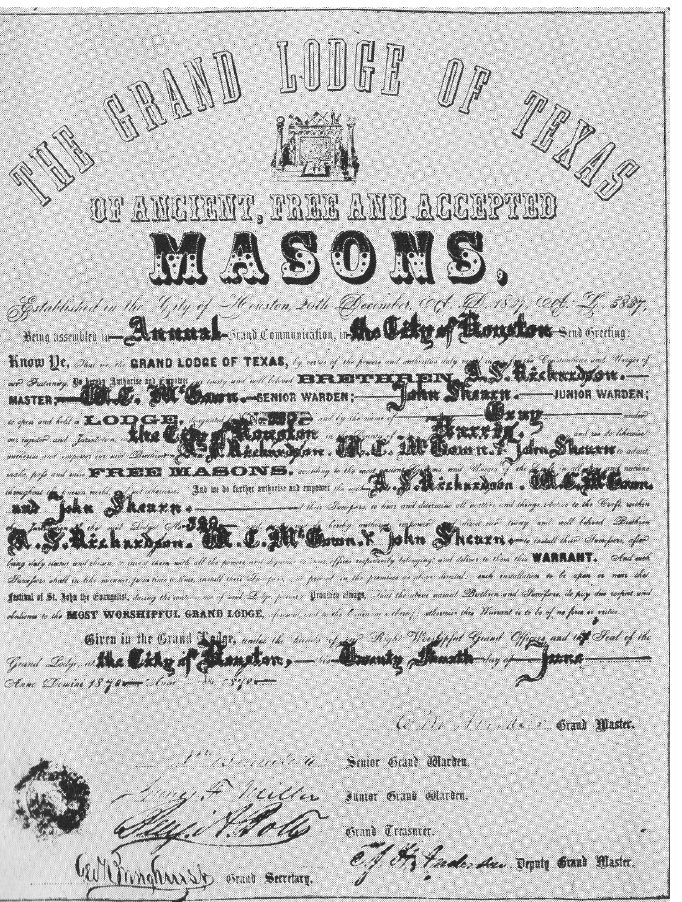
Twenty-two Master Masons, most of them members of Holland Lodge No. 1, signed the petition for Gray Lodge on May 11, 1870, and asked Holland Lodge to endorse it. Holland took the request seriously, discussing it “pro and con” before giving its unanimous consent on June 8, on the understanding that Gray Lodge would meet on the first and third Wednesdays and that neither lodge would lower its degree fees without the other’s consent. Its resolution ended with words of real warmth:
“Resolved that we part with applicants from Gray Lodge with regret and in fraternal cordiality and bid them God speed in their labors.”
The petition went before the Grand Lodge of Texas, then holding its annual communication in Houston, on June 14. The next morning the Committee on Petitions recommended a charter, naming A. S. Richardson as Worshipful Master, Dr. W. C. McGown as Senior Warden and John Shearn as Junior Warden. On June 24 the $25 fee was paid, and Brother Cyrus Gault of Holland Lodge filled in the charter in beautiful script.
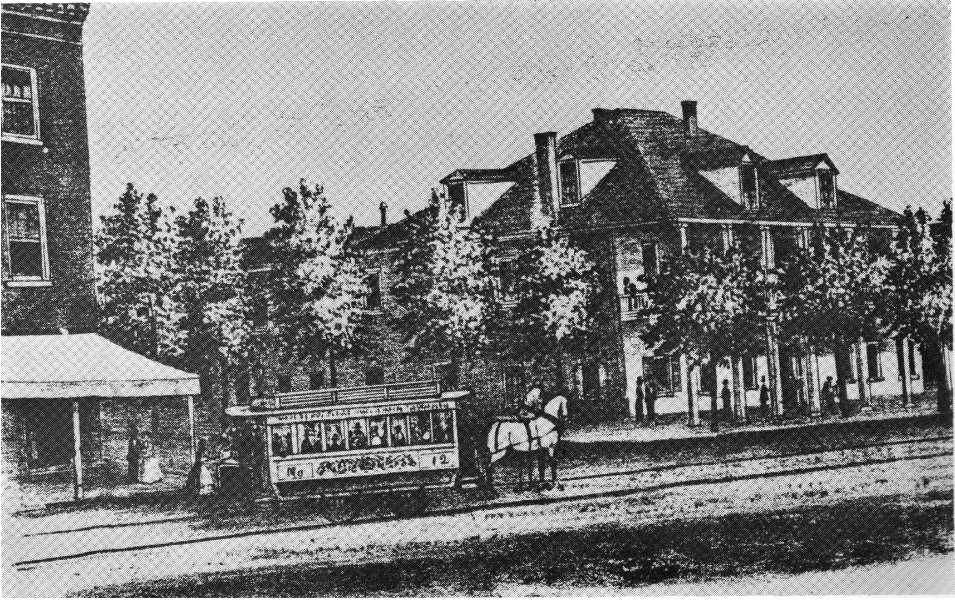
On the evening of June 24, 1870, the anniversary of the birth of St. John the Baptist, the brethren gathered in the hall of Holland Lodge in the J. J. Judson Building at 601–603 Main Street, on the southwest corner of Main and Texas. Right Worshipful Past Grand Master Peter W. Gray, son of the lodge’s namesake, presided as acting Worshipful Master and installed the officers, assisted by Past Grand Master E. W. Taylor and District Deputy Grand Master James W. Henderson. Eighteen of the twenty-two charter members were present.
After Worshipful Master Richardson gave his first address, the lodge read a letter from Peter W. Gray presenting a set of silver officers’ jewels and a Holy Bible in memory of his father:
“That your minds may be illuminated by the precepts of that Great Light – that your Jewels of Virtue and Charity may ever brightly shine; and that your Lodge may excel in good works and prosper in peace and harmony, is my prayer to the Great Architect.”
The new lodge appointed committees to write its by-laws and find a lodge room, and closed “in peace and harmony.” A collation followed in honor of the new lodge and the Feast of St. John, at which, as the Daily Times reported, “harmony and friendship prevailed as usual on such occasions.”
The officers installed that night, as recorded in the lodge’s first minutes.
Worshipful Master
Senior Warden
Junior Warden
Treasurer
Secretary
Senior Deacon
Junior Deacon
Senior Steward
Junior Steward
Tiler
Gray Lodge started with a remarkably varied membership. Eight charter members were born abroad, in England, France, Germany, Switzerland, Italy and the Sandwich Islands, now Hawaii. Others came from Alabama, Connecticut, Kentucky, Ohio, South Carolina, Tennessee and Virginia, and only two were native Texans. Among them were eight merchants, five lawyers, two physicians, two bookkeepers, an auctioneer, a cotton factor, a railroad conductor, a sail maker and a printer. They brought real Masonic experience: four were already Past Masters, and between them they had been made Masons in lodges from Switzerland to San Francisco.
22
charter members
8
born in other countries
2
born in Texas
4
already Past Masters
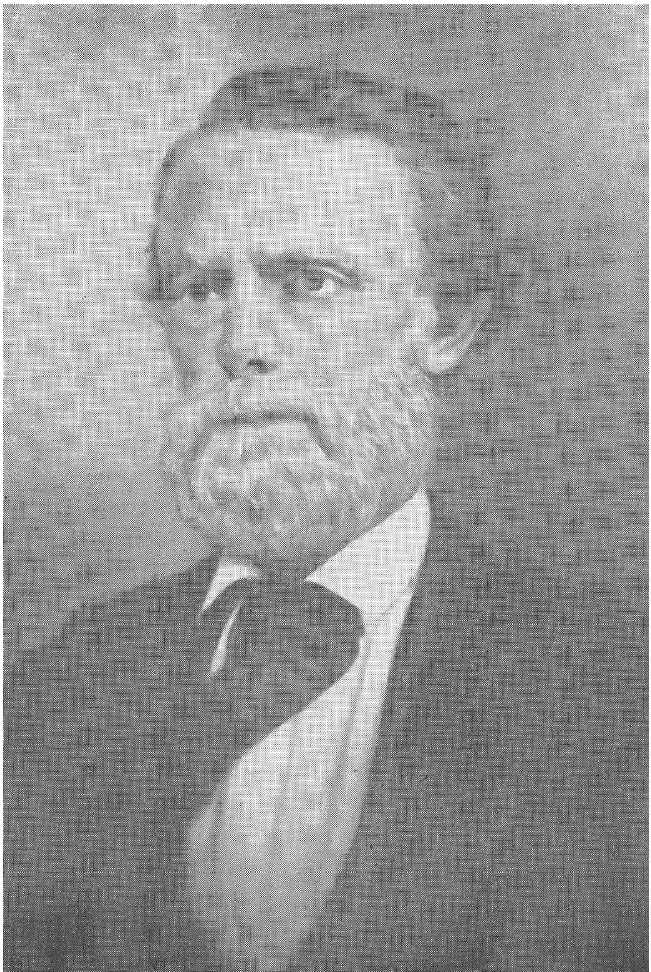
The men who signed the petition of May 11, 1870, in alphabetical order. Six of them went on to serve as Worshipful Master of Gray Lodge, and two became Grand Masters of Masons in Texas.
Second Worshipful Master
A major in Hood’s Texas Brigade and later Postmaster of Houston. On Founding Day he stood as proxy for the absent Senior Warden and was named to find the new lodge a home.
Born in the Sandwich Islands (Hawaii)
A merchant who traveled to New Orleans at his own expense to study lodge rooms, then made Gray’s “one of the most attractive in the state.” On St. John’s Day 1873 he gave the books that began the lodge library.
Born in Salem, Alabama, 1842
A four-year veteran of Terry’s Texas Rangers, cotton factor and wholesale grocer, and longtime president of the Houston Cotton Exchange. The Houston Post called him “Houston’s first citizen,” and Cleveland, Texas, is named for him.
Born in Switzerland
A watchmaker and jeweler on Main Street, made a Mason in L’Egalité Lodge at Fleurier. He was Gray’s first Treasurer, from 1870 to 1877, then its Tiler until 1888, and served many years as Grand Tiler of Texas.
Born in Germany
A merchant and Civil War veteran wounded at Gettysburg. He served as Gray’s first Junior Steward while still Senior Steward of Holland Lodge, and later as Grand Junior Steward of Texas.
Worshipful Master, 1876–1877
A Houston lawyer made a Mason in Widow’s Son Lodge No. 60 at Charlottesville, Virginia, and the law partner of fellow charter member W. C. Wilson. He served on the committee that found the lodge its first room.
Born in Mobile, Alabama
A clerk made a Mason in Pascagoula, Mississippi, in 1857. He was the first Secretary of Gray Lodge, keeping its records from Founding Day through 1875.
Born in Savoie, France
A grocer at the corner of Travis and Congress, raised in Holland Lodge in 1868. He was the first Senior Steward of Gray Lodge.
Worshipful Master, 1873–1874
The first Senior Deacon, through whom Peter W. Gray presented the lodge’s silver jewels and Bible. He was the last surviving charter member of Gray Lodge.
Worshipful Master, 1885–1886
The first Junior Deacon of Gray Lodge, who later served as its Worshipful Master.
Born in Franklin County, Tennessee, 1824
A physician and four-year Master of Lafayette Lodge No. 34 at La Grange, where he was one of three doctors who stayed at their posts through the 1867 yellow fever epidemic. He was the first Senior Warden of Gray Lodge.
Born in Virginia
A physician with a drug store at 96 Main Street, who affiliated with Holland Lodge in 1866 after coming to Houston following the Civil War.
Born in Naples, Italy
A sail and tent maker, raised in Holland Lodge in 1867. He was the first Tiler of Gray Lodge.
Born in Colchester, Connecticut, 1821
A Texan since 1838 and a county judge at La Grange and Bastrop. As a Confederate dispatch rider he covered the 290 miles between Houston and Alexandria, Louisiana, in forty hours. He was elected Grand High Priest of Texas just nine days before Gray Lodge was constituted.
First Worshipful Master
Gray Lodge’s first Master, later Grand Commander of Knights Templar and Grand Master of Masons in Texas, 1889–1890. The Richardson Lecture, held each October, bears his name.
Born in Bath, England, 1826
As a boy of nine he saved his father’s life at Goliad in 1836 by pleading with the Mexican general in Spanish. A leader of the Buffalo Bayou Ship Channel Company, he was Gray’s first Junior Warden and an uncle of Col. Edward M. House.
Born in England
A printer whose firm, J. Smallwood & Company, did book and job printing at Fannin and Congress. He had served as Senior Warden of Holland Lodge in 1867.
Born in Ohio
A railroad conductor who began his Masonic journey in Harmony Lodge No. 6 at Galveston. He served as Tiler of both Gray and Holland Lodges and as Grand Tiler of Texas.
Worshipful Master, 1875–1876
Later Grand Master of Masons in Texas, who laid the cornerstone of the Harris County courthouse in 1883, and a member of the U.S. Congress for ten years.
Born in Orthez, France
A clerk and grocer who served as the second Tiler of Gray Lodge, in 1871 and again from 1875 to 1878, while also tiling for Holland Lodge.
Made a Mason in Vicksburg, Mississippi
A bookkeeper raised in Hill City Lodge No. 121 in 1853. He served as Junior Warden of Holland Lodge in 1865 before joining in founding Gray.
Born in Newberry, South Carolina, 1829
He graduated from Erskine College with honors at sixteen, practiced law at Fairfield, served as a Confederate captain and a Texas state senator, and became W. H. Crank’s law partner. The Telegraph called him “an exemplary citizen and a finished lawyer.”
The lodge these twenty-two men founded has met in Houston ever since. Meet the Masters who led it, or come see us on a Thursday evening.