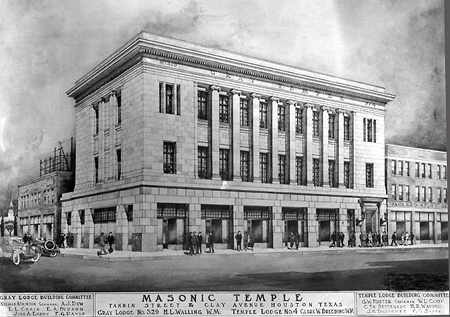
Houston's Second Oldest Masonic Lodge
Gray Masonic Lodge No. 329 A.F.A.M.

Serving Houston since 1870 · 2370 Barker Oaks Drive, Energy Corridor

Our History: Serving Houston Since 1870

Founded in 1870, we are Houston’s second oldest Masonic Lodge. On May 11, 1870, twenty-two Master Masons, in response to the growth in Houston’s population, signed a petition requesting a charter for a new lodge from the Grand Lodge of Texas. The Grand Lodge granted that charter on June 24, 1870, and Gray Lodge No. 329 was constituted in the hall of Houston’s first Masonic Lodge, Holland Lodge No. 1.

This Lodge was named for William Fairfax Gray, who was in Texas as a land agent and attended the convention at “Washington-on-the-Brazos” in 1836 when Texas declared independence from Mexico. Gray moved his family from Virginia to Houston in 1837. He was by profession an attorney, and served as clerk of the Republic of Texas House of Representatives and the Senate in 1837 and 1838.

In 1991 the Texas Historical Commission recognized the lodge’s place in Houston’s history with an official state historical marker, which stands beside the main entrance of our lodge today.

Over the years, the organization has been involved in a variety of community activities. Masons from Gray Lodge were among the first to respond to victims of the devastating Galveston storm in September 1900. A Masonic relief committee distributed groceries and medicine, and a temporary relief committee was authorized to provide assistance.

That spirit continues today. You will find Gray Lodge brothers volunteering with the Houston Livestock Show and Rodeo, the Arabia Shrine Circus, and the Houston Food Bank. Since 1929, our Humphrey Benevolent Fund has quietly helped brothers and their families through hard times, and you can support the Humphrey Benevolent Fund here.

Gray Lodge No. 329 continues to serve the community and promote a spirit of brotherhood and good will.

The Man Behind the Name: Col. William Fairfax Gray

Walk into Gray Lodge and you are stepping into a story that begins at the birth of Texas. Born in Fairfax County, Virginia, in 1787, William Fairfax Gray served in the Virginia militia during the War of 1812 and rose to the rank of lieutenant colonel. He was known as “Colonel Gray” for the rest of his life.

When Gray came to Texas as a land agent in 1835, he could not have known he would witness history. He was present at Washington-on-the-Brazos throughout the Convention of 1836, and the diary he kept there remains one of the most valuable eyewitness records of the Texas Revolution. In places it is more complete than the Convention’s own official journal. His entry for March 2, 1836, records that the Texas Declaration of Independence was adopted in less than an hour, without a single amendment. The diary was published in 1909 as From Virginia to Texas, 1835.

After settling in Houston, Gray went on to serve as district attorney and as the first clerk of the Texas Supreme Court. He was a Mason, the principal founder of Christ Church, Houston’s first chartered congregation, and a founding officer of the Philosophical Society of Texas. He died in Houston in 1841 and rests in Glenwood Cemetery.

His legacy runs through our lodge. His son, Judge Peter W. Gray, was an active Mason who founded the Houston Lyceum, forerunner of the Houston Public Library, and in 1870, the year Gray Lodge was chartered, he became the first president of the Houston Bar Association. Gray County, Texas, bears his name. Our first Worshipful Master, Alfred Stephen Richardson, studied law under Judge Gray and later married a niece of Col. Gray.

Col. William Fairfax Gray at a Glance

  • Born: November 3, 1787, Fairfax County, Virginia
  • Military: Virginia militia, War of 1812; lieutenant colonel, 1821
  • Witness to history: Convention of 1836 at Washington-on-the-Brazos
  • Public service: Clerk of the Republic of Texas House, 1837, and secretary of the Senate, 1838
  • Houston: Principal founder of Christ Church, 1839
  • Died: April 16, 1841, Houston

Our Home Through the Years

For more than 90 years, Gray Lodge met in downtown Houston, on the same streets where its founders practiced law, ran businesses, and fought fires. As the city grew west, so did the lodge, moving to Houston’s west side in 1964 and to its present home at 2370 Barker Oaks Drive in the Energy Corridor in 2006.

Today you will find the lodge just off Highway 6 near Westheimer, in a building that has been featured in video and print for its beauty. If you are driving by, look for the Texas historical marker beside the front door. Better yet, stop in on a Thursday evening and see it for yourself.
The Men Who Built Gray Lodge, and Houston

The roster of Gray Lodge reads like a history of Houston. Here are a few of the men who have served as our Worshipful Master.

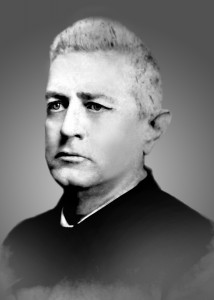
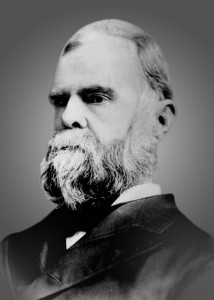
Portrait of Alfred Stephen Richardson, first Worshipful Master of Gray Lodge No. 329

Alfred Stephen Richardson

First Master, 1870–1871, and Grand Master of Masons in Texas

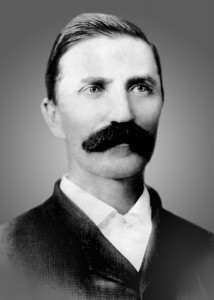
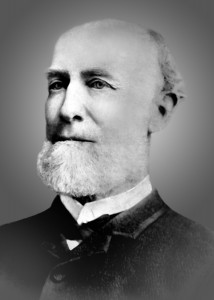
Portrait of Robert Burns, second Worshipful Master of Gray Lodge No. 329

Robert Burns

Second Master, a major in Hood’s Texas Brigade, and Postmaster of Houston

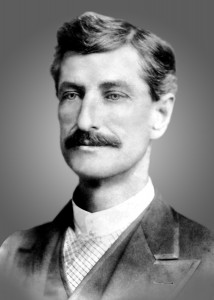
Portrait of Charles Stewart, fifth Worshipful Master of Gray Lodge No. 329 and Grand Master of Texas

Charles Stewart

Fifth Master, Grand Master of Masons in Texas, and ten years in the U.S. Congress

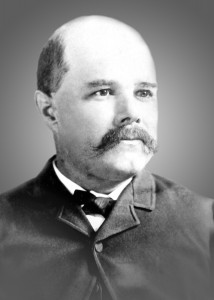
Portrait of William J. Settegast, seventh Worshipful Master of Gray Lodge No. 329

William J. Settegast

Seventh Master, orphaned at ten, and the first Master raised in Gray Lodge

Portrait of Judge W. Nelson Shaw, twelfth Worshipful Master of Gray Lodge No. 329

Judge W. Nelson Shaw

Twelfth Master, Harris County judge, and a co-founder of the Kirby Lumber Company

Portrait of James Robert Cade, sixteenth Worshipful Master of Gray Lodge No. 329

James Robert Cade

Sixteenth Master and namesake of Houston’s Cade-Rothwell Lodge No. 1151

An Annual Tradition of Masonic Education

Each October, Gray Lodge welcomes a renowned Mason, author, or historian to deliver the A.S. Richardson Lecture, named for our first Worshipful Master. Modeled on England’s famous Prestonian Lectures, it is a tradition few lodges anywhere maintain, and it reflects our belief that a lodge should be a leader in Masonic thought and education.

Portrait of Alfred Stephen Richardson, first Worshipful Master of Gray Lodge No. 329

Freemasonry and the Birth of Texas

You cannot tell the story of Texas without telling the story of its Masons. In 1828 Stephen F. Austin gathered the Masons of his colony at San Felipe and was elected Master of a lodge that Mexican authorities never allowed to be chartered. In 1835 a handful of Masons at Brazoria organized Holland Lodge, only to see its records and furnishings destroyed by the Mexican army during the Revolution.

The men who won Texas independence were steeped in the Craft. Travis, Bowie, Crockett, Bonham, and Fannin were all Masons, as were Stephen F. Austin and Sam Houston. After the war, Holland Lodge reopened here in Houston, and in December 1837, with President Sam Houston presiding, Masons met in this city to organize the Grand Lodge of the Republic of Texas and elected Anson Jones as its first Grand Master.

When you join a Houston lodge, you are joining the same tradition that helped found the Republic.

Texas Masons Helped Build Its Schools

Long before Texas had a public school system, Texas Masons were building schools. The Grand Lodge created an education fund in 1847, and between 1850 and 1873 the Legislature chartered seventeen Masonic-sponsored schools. Masons helped start more than a hundred more, and many frontier lodges were built as two-story halls, with the lodge room upstairs and a schoolroom for the town’s children downstairs.

Texas Masons honor President Mirabeau B. Lamar, himself a Mason, as the father of Texas education for setting aside public land to fund schools in every county. The Grand Lodge’s Mirabeau B. Lamar Award for Excellence still recognizes outstanding Texas students and teachers today.

What is the History of Freemasonry?

Freemasonry is a fraternity. Its membership is restricted to men, but there is no hazing as is found in some college fraternities. The Masonic Order is a serious group. It exists to take good men and help them to become better men. Thus, it is not a reform society. It does not exist to reform criminals, nor would such persons benefit from its teachings.

Variously known as “Freemasonry”, “Masonry” or “The Craft”, the beginnings of our fraternity are lost to history. Although Masonry is believed to be the oldest surviving fraternal organization in the world, the exact date of its founding is uncertain. Freemasonry can, however, be easily traced to 16th-century Scotland, although the first Masonic governing body was not founded until 1717 in London. The oldest Masonic document, the Regius poem, dates to around 1390 A.D. We know of no Masonry prior to that date. Sometime between 1390 and 1717, lodges of operative masons began to accept as members men who did not work in the building trade. Eventually whole lodges composed of such

persons arose, leading to a transition from lodges being composed of stone masons to lodges being composed of men from other occupations who gathered and shared a ritual replete with allusions to carpentry, architecture, and stone masonry.

In 1717, four of these lodges in England met and formed the first Grand Lodge. A Grand Lodge is a Masonic body having jurisdiction over the lodges within a certain geographical area. In the U.S.A., each state and the District of Columbia each have its own Grand Lodge.

Symbolic, Craft, or Blue Lodge Masonry has three degrees: Entered Apprentice, Fellow Craft, and Master Mason. In early Speculative Masonry, there was only one degree. Later a two-degree system developed, and finally the three-degree system of today evolved and was firmly in place by around 1760 A.D.

A “degree” is a drama in which a newcomer to Masonry, the candidate, is made to play a key part. These dramas have several characteristics and are progressive in nature; that is, they build on each other. These dramas are enacted with only Masons present, and are for the purpose of moral instruction. A unique characteristic of each Masonic degree is an “obligation” taken by the candidate. The obligation is an oath taken for the purpose of instructing the candidate in his Masonic duty.

The three degrees have a biblical basis. Much biblical imagery is used in the ritual of the degrees. The central biblical image used in Masonic ritual is that of the building of King Solomon’s Temple, as meticulously described for us in the Old Testament books of I Kings and II Chronicles. Whenever a Masonic lodge is in session, the Holy Bible is open upon the lodge’s altar.

Freemasonry Requirements

Masonry requires of its adherents a belief in God and in life after death, though it asks no one to expound upon the particulars of his understanding of those two beliefs. The candidate must learn some memory work after each degree is conferred upon him. He has a set amount of time to learn this catechism (a set of questions and answers), and to recite them before the lodge members at a lodge meeting.

Masonry is not a religion. There is nothing in Freemasonry to interfere with a man’s religious life. Persons of all faiths and Christian denominations are a part of the worldwide Masonic fraternity. Religion and politics are two subjects never allowed to be discussed when a lodge is in session.

Masonry teaches the importance of helping the less fortunate. It especially stresses care for the widows and orphans of Masons. Indeed, most Grand Lodges have within their jurisdiction a home for aged Masons, their wives and widows; and also a home for Masonic orphans. Here in Texas alone, Masonic lodges and charities award millions of dollars in college scholarships every year, and most of that help goes to students with no Masonic connection at all.

Masonry asks its candidates not to tell the details of its ritual to non-Masons. This is not because Masonry is ashamed of anything. It is because an element of secrecy serves to heighten interest in Masonic teaching. It is also because most people would not benefit from being introduced to Masonic teachings out of the context of the Masonic degree system.

Why Do Masons Keep Their Rituals A Secret?

For the same reason that the ancient stonemasons kept their trade secrets: Secrecy helped to maintain a better quality of work. Our secrecy today helps us to make a good man better, but having secrets does not make Masonry evil. It is difficult to believe that the secrets of Masonry are evil when you consider the heritage of Masonry that includes a long list of influential leaders such as Paul Revere, George Washington, Andrew Jackson, Theodore Roosevelt, Douglas MacArthur, Franklin D. Roosevelt, Harry Truman, Stephen F. Austin and Sam Houston. It is difficult to believe that the secrets of Masonry are evil when you see so many Masons working as a vital part of every community to provide better churches, better schools and better governments. It is difficult to look into the eyes of a little child in a Shrine Hospital and believe the secrets of Masonry are evil. If we really believe the biblical teaching, “by their fruits ye shall know them,” then we must believe that the secrets of Masonry really do help to make a good man better.

The influence of Masonry is like the influence of the home and the influence of the church. It cannot produce perfect human beings. Despite the best efforts of the home, there has never been a perfect child. Despite the best efforts of the church, there has never been a perfect Christian. Despite the best efforts of Masonry, there has never been a perfect Mason. Nevertheless, there is a place for all these in our society. Man’s basic nature is such that he needs every good influence he can get. He needs the powerful influence of a good home. He needs the powerful influence of a dedicated church made up of dedicated believers. He needs the influence of dedicated teachers in the public schools. But, when all is said and done, it doesn’t hurt to have a little extra push that comes from civic organizations, from professional organizations and from fraternal organizations.

Masonry has a proud heritage of service to the State of Texas since 1837, and we hope this discussion has helped you come to a better understanding of the purpose of our fraternal organization. Texas Masonry now looks to the future with the hope that a better understanding will allow the lodge to take its rightful place in every Texas community, right alongside of the church, the home, the schools, and the civic organizations as a positive force for good. With this better understanding, there is every reason to believe that we can all work together to make our government, our schools and our churches even stronger than before. The strength of Texas has always been built upon the combined efforts of all these groups, and the Grand Lodge of Texas has contributed valuable service to our churches, our nation, our state and our community.

Where Masonic Charity Goes Today

Charity is one of the great principles of Freemasonry, and in Texas it is measured in real students and real families. Masonic Children and Family Services of Texas awards 200 college scholarships of $2,500 every year to Texas high school seniors, and Masonic affiliation is not required to apply. Almost 600 Texas lodges offer scholarships of their own, and Texas Freemasonry has given more than $16 million in scholarships since 2010. The Texas Masonic Charities Foundation helps local lodges support their fire departments, libraries, food pantries, toy drives, and veterans.

Texas Masons also support Scottish Rite for Children in Dallas, Shriners Children’s, and the Texas Masonic Retirement Center, caring for children and families across the state and beyond.

Come Meet Us on a Thursday Night

The best way to learn about Freemasonry is to sit down with Masons. Every Thursday at 6:00 PM, Gray Lodge gathers for dinner, fellowship, and Masonic education, and you are welcome to join us. By long tradition, Masons never recruit, so if you are curious, the first step is yours: come by, ask questions, and get to know us. Our stated meetings for members are held the first Wednesday of every month at 6:30 PM.

2370 Barker Oaks Drive, Houston, Texas 77077